


Macro-level Analysis: Conditional Effect Plots
The first step of our investigation on the internal data structure is to evaluate the the difference in the correlation between interest similarity and retweeting behaviour under different propagation structures.
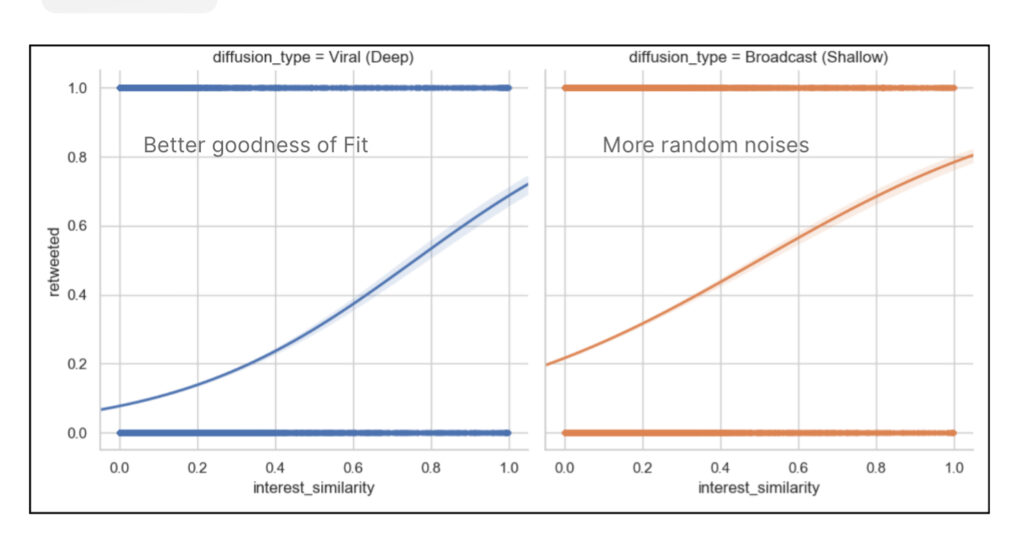
Through comparing the plots, we discovered that the unit increase of interest similarity in the broadcast diffusion was reduced at a greater extent compared with that of the viral diffusion. This result inspired us to further explore the dynamic relationship between interest similarity and retweeting probability at different stages of the diffusion.
Python Code Display
Descriptive Statistics: Attenuation in Average Interest Similarity
A decay analysis was conducted to verify the trend of decreasing interest similarity detected in the macro-level analysis. The size of the blue area represents the scale of users (or nodes) involved in retweeting.


According to the decreasing number of nodes and the downward-sloping curve, we inferred that users who pursued highly-matched interest tend to assemble at the initial stage of diffusion, while those users excluded by interest homogeneity concentrated when depth was above 0.5.
Python Code Display
Micro-level Analysis: Sliding Window Analysis
We applied a sliding window analysis to compartmentalise the change in interest similarity at depth 1-2, 2-3, and 3-4.

It came out that the logistic regression coefficient of interest similarity decreased monotonically as the information spreads in either depth or width. This indicated the weakened marginal impact of interest similarity on retweeting behaviour as depth increases.
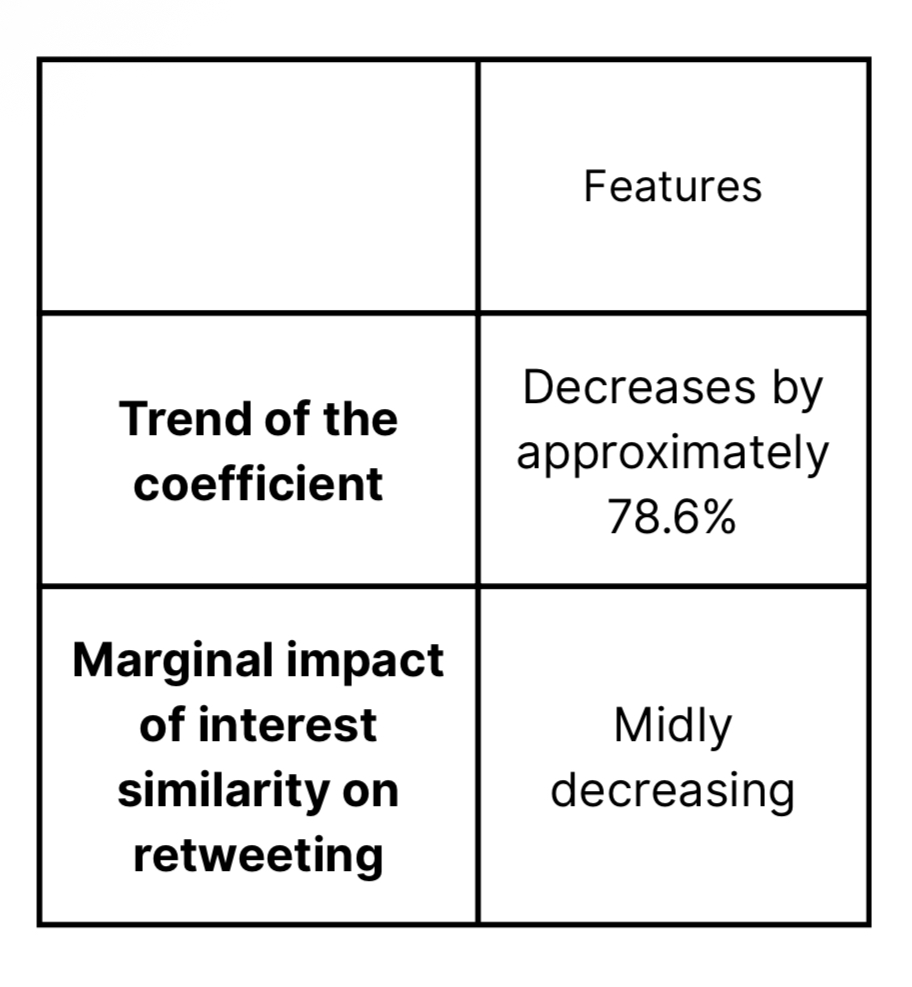
To confirm the boundary between the growth stage and plateau stage of interest similarity, we visualised the conversion effects of interest similarity in viral and broadcast structures respectively in the following section.
Python Code Display (Modified Version)
Validating the Phase-based Nature of Propagation Pathway
The data of conversion lift by interest similarity threshold showed that the two diffusion structures shared the same optimal threshold. However, the increase in conversion lift above the threshold was much higher in depth 3-4 (secondary stage) rather than in depth 1-2 (primary stage).

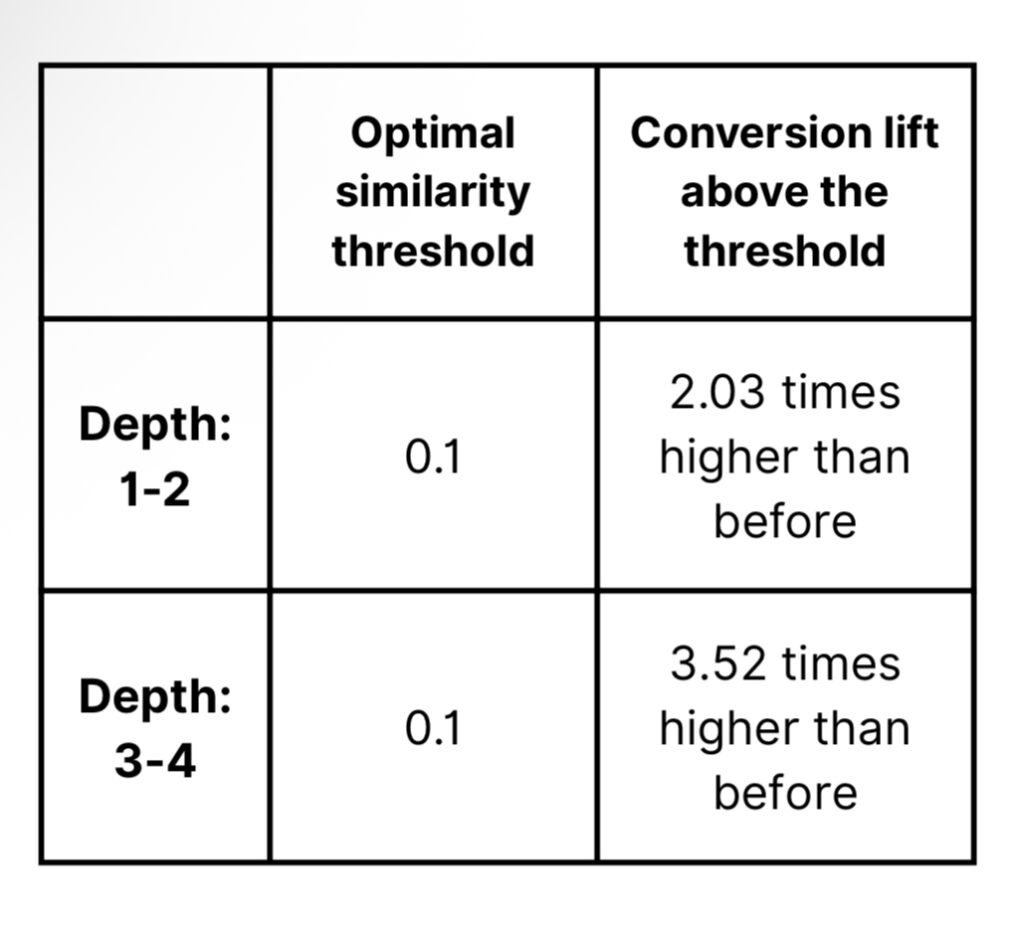
In other words, the effect of highly matched user interest similarities on retweeting behaviour between was magnified at greater depth. A societal interpretation for this phenomenon is that interest-driven diffusion actions become more scarce during the secondary stage of propagation.