



Propagation Graph
In this section, we use the data to build the propagation graph for each diffusion.
Then, we count the number of viral patterns versus broadcast patterns.
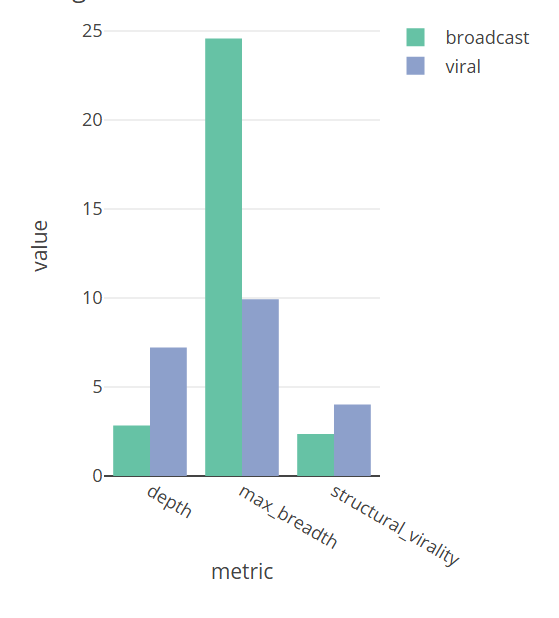
We classified cascades into broadcast-like versus viral-like based on four structural features: depth, breadth, root dominance, and structural virality. We first ran K-means with two clusters, then labelled the cluster with higher depth and structural virality, but lower breadth and root share, as viral; the other cluster is labelled broadcast.
Propagation Graph Result

*We did not display graphs with size <10
Broadcast versus Viral
Example of Broadcast Pattern

Example of Viral Pattern

Broadcast-like cascades are wider but shallower, while viral-like cascades are deeper, more structurally distributed, and more dependent on audience-content fit, reciprocity, and repeated exposure.
Dynamic Graph Display
Conclusion
The driving result for broadcast/viral cascade is different.
Broadcast pattern relies more on influential root user, first hop reach and leading accounts driving. Features related includes avg_interaction, log_root_followers.
Viral pattern relies more on repetitive exposure, mutual benefits, matched interest and longer consistent promotion. Features contributing to depth significantly are avg_number_of_exposure, mean reciprocity, avg_interest_similarity, time_span.
Additionally, viral pattern and broadcast pattern still vary even if their size is the same. Also, the average root followers of broadcast pattern are 407,117 while viral pattern is 47,479. But their average size difference is only around 17%. This shows that more root followers do not necessarily lead to large diffusion size. Deep diffusion is driven more by mechanism than broad reach. Some important factors include audience-content fit, repeated exposure, reciprocity and favourable network pathway.